Is It Really Worth Installing a Rainwater Tank?
Shôn Ellerton, August 15, 2025
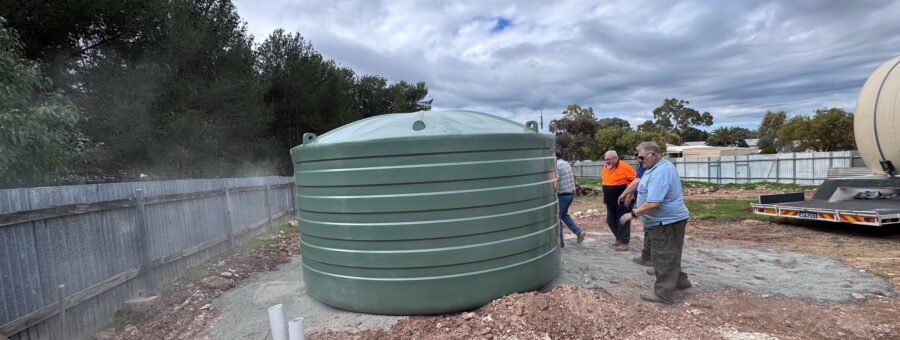
Unless you live on a large block of land or out in the boon docks, is there any advantage of having a rainwater tank installed on your property?
Many years ago, just after purchasing my first home, I was presented with a rather expensive problem. A collapsing retaining wall along the side of the house in which there was access via a gate to the back garden from the front.
Blocking most of the alley was an old rusty 2000-litre rainwater water tank in very bad condition. It didn’t serve any purpose for my needs. It had no pump, the fittings were worn and bad, and, frankly, it just stood there collecting water, algae, and mosquitoes during the summer months.
I decided to remove it because it would have been nearly impossible to fix the wall with it in place.
The wall was eventually fixed and there is now a nice uncluttered walkway to the veranda at the back of the house. I never thought of replacing it with another rainwater tank because the economics simply don’t justify it.
I’m probably making some grand assumptions but if my calculations are correct, getting a rain water tank is a remarkably poor investment.
I live in a medium density suburban neighbourhood in a south Adelaide metropolitan area which receives enough rainfall and designed to soak up torrential rainfall without flooding the stormwater drains.
Assuming I can fit a 10,000 litre tank, this would set me back $2000. That’s not including the labour to fit it and all the ancillaries like pumps, connections, and piping required. It’s more likely the cost will be in the region of $4000.
My house has a usable roof area of 200 square metres. The average rainfall of Adelaide is about half a metre, which means the maximum I could get is 100 cubic metres of water, which is 100 kilolitres.
Water prices at time of writing is around two dollars for each kilolitre, meaning that, the absolute maximum I could save is around $200 a year. In other words, it would take at least ten years to pay this back.
But this is unrealistic.
This is assuming that I can use and refill the tank ten times in each year. Bearing in mind that there are wetter times of the year than others, this is unlikely. I would say, conservatively, I could only refill the tank five times at best, the rest of which will be out through the overflow during the wettest months.
This brings the rate to pay back the tank at nearly twenty years.
I am also assuming that I could use all of the water, which is impossible.
First, the water will not be used for drinking water and will only be fitted to flushing the toilets and watering the garden, which is necessary only during the summer months.
Second, you won’t be able to use all the tank because, due to council stipulations, you will probably only be allowed to retain around half of it. I’ll explain more about this little catch later.
You still have to pay the roughly one dollar a day services fee and another dollar a day sewerage charge.
Based on the fact that water tanks tend to have a service life of around twenty years and coupled with all the additional factors listed above, this makes absolutely no financial sense at all.
In fact, this is actually a loss-making exercise in a big way.
Many of us get caught up in avidly purchasing a rainwater tank to offset water usage costs, be self-sufficient when the water supply gets shut off, and for saving the environment. They are all totally acceptable reasons for anyone to consider purchasing a rainwater tank but are they all valid reasons?
As I alluded to above, the economics of buying a rainwater tank for purely financial savings, at least in urban and suburban environments, is totally flawed.
Let’s delve even further.
Let’s start with the average block size using Greater Adelaide as an example.
According to the Australian Bureau of Statistics, the average block size during the 80s was 780 square metres. During the 90s, it was 644 square metres. Around 2005 or so, it was 560 square metres. During 2024, it shrank to 450 square metres and it is expected to drop to 365 square metres by 2026.
I think one can safely assume that block sizes have nearly halved and, not only that, it is quite obvious that the average house sizes have increased over the years. There are new developments that have been created which crams in so many single-storey houses on very small parcels of land, that it is nigh-on impossible to undertake any renovation due to access issues. There is virtually no privacy, parking is a challenge, noise from neighbours and barking dogs is problematic, there is increased fire risk, and, of course, the underlying infrastructure servicing electricity, water, and sewerage is often overstressed.
I wrote a piece titled Are Property Subdivisions Going Out of Control back in 2018 which highlights many of these issues including the sheer greed of investors wanting to get into the action of getting high return on investments from their subdivided properties. We won’t go into these topics but rather on why rainwater tanks may be a flawed investment and how unsuspecting buyers have been duped into buying them.
If you ask most anyone why they want a rainwater tank, the answer will most likely be because they want to cut costs by using the water in the tank to flush the toilets and water the garden. Considering that garden sizes have dramatically been reduced over the years because of shrinking block sizes and increasing house sizes, I highly doubt that anyone would realise a positive return on investment on the purchase of a rainwater tank. Despite government rebates being available for rainwater tanks, there is still a considerable outlay to purchase one, properly connect it up by a registered plumber and procure all the accessories like electric pumps and whatnot.
However, your local council wants you to have a rainwater tank. Some insist that you have one installed as part of building a new home. The rebates are there to entice owners without water tanks to get one on the condition that they are then unable to remove it at their own discretion in the future. They certainly won’t foot the costs for maintaining it or to replace it when they become unusable, which is, on average, a period of about twenty years or so.
This is not to help you but to help them.
The councils are not particularly interested in saving water for the sake of the environment. They are certainly not interested in you saving money for having a rainwater tank. The reality, for most, is that you will lose money anyway.
There are two reasons why councils want you to have a rainwater tank.
The first reason is fully justifiable, that those with rainwater tanks might be able to assist in fighting fire in those areas which are more highly prone to bushfire. The fire brigade could hook up to residents’ water tanks and use retained water in the rainwater tanks to put out fires. After all, nobody wants their house caught up in a fire.
The second reason is a complete and total copout.
To give a little history of why this struck so resoundingly to me.
I was once a civil engineer in my earlier days and, funny enough, one of the first things I had to design was a stormwater drainage system for a new housing development on the outskirts of Ashford, a medium-sized town in Kent in England. The general idea is to move as much water away from the suburb during torrential rain but also design the system that there is enough flow velocity to facilitate the movement of water without creating stagnant pools and build-up of sedimentation. It’s a fine balance of orchestrating the movement of storm water from small pipes into larger pipes in the most efficient way as possible.
Now, there’s a lot that goes on within the brain of an engineer when these things are designed.
A competent engineer must be educated in the world of hydraulics, the design of machinery and infrastructure to facilitate the movement of fluids. Fluid mechanics, the rather complex mathematics behind it all. And hydrology, the fun bit in which you plot unit hydrographs, which are like peaks on a graph in which the taller and thinner the peak, the more drastic the amount of water coming by at a very short time often blocking drains and causing damage to infrastructure. Of course, you have to know about concrete design, soil mechanics, and lots of other techy stuff like geodetic engineering to set it all in the right place.
Clearly, civil engineers have either lost these skills over time or building developers are taking the greedy option and ignoring their advice and taking shortcuts.
I’d probably bank on the latter option.
With ever-decreasing blocks of land and larger house sizes, there is very little in the way of ground features which can slowly absorb water, like lawns, for example. With building developers, often in cahoot with councils and government agencies, cutting down infrastructure costs to cope with very substantial flows of storm water is one of their main focus points. So, instead of designing adequate stormwater facilities, why not force residents in these already overcrammed block sizes to have great big, and often ugly, rainwater tanks which they don’t really need.
Now, you may be thinking, what does this have to do with the stormwater drainage system coping with large spikey volumes of water?
Well. Going back to that unit hydrograph, you want to make it wider and flatter. Remember, the pandemic days during 2020 when we had to try to ‘flatten the curve’? The same thing applies here. A tall and peaky graph is like a flash flood while a flatter wider peak is more like a tranquil river.
Because these high-density neighbourhoods have so little in the way of soft surfaces for slowly releasing the water into the stormwater system, many councils are building into their stormwater plans and regulations to use residents’ rainwater tanks as a means of mitigating the risk of stormwater surges.
Many may not realise is that councils stipulate that a sizeable portion of the rainwater tank be used for detention as well as retention. Retention is the amount at the bottom of the tank which is used for storing the water for a later time. Detention is the amount at the top of the tank which is kept empty. There is an overflow pipe fitted at the level where the top of the retention bit meets with the bottom of the detention bit. Usually around the halfway mark in many urban areas dependent on council regulations.
The purpose of the detention portion at the top of the tank is that it is used to slowly discharge rainwater into the stormwater system when there is rainfall. In other words, the water coming from your roof will fill up the detention part quickly but adds more time for the water to spill into the stormwater system. Of course, there is another overflow at the top of the detention portion should there be long and sustained rainfall.
Basically, it is the property owner that has to come to the rescue of stormwater designs which are not built to cope with expected runoffs. This is a copout because any competent civil engineer would have designed the stormwater system to cope with heavy rainfall events.
And yes, this is expensive, but it also illustrates the insanity and greed of building developers cramming so many houses into a small area out in the suburbs! Vertical living in the middle of the city, in which there are far more residents per square kilometre, is one thing, but out in the far suburbs? Australia is one of the last places I can think of where land scarcity is an issue.
Now here’s the rub.
How big is the, normally empty, detention bit at the top of the tank?
It depends on land size, but for most suburban areas, it is around fifty percent but it ultimately depends on the council. For example, the council of Unley in Adelaide has a detention ratio of just less than half. That means, if you had purchased a 3000 litre tank, you can only retain around 1500 litres of water! Unless, of course, you did something naughty and plugged up the overflow on purpose.
I recently met up with a rainwater tank installer and he told me that there are planned new high-density neighbourhoods that will stipulate 70 percent detention. In other words, you as the resident can only hold 30 percent of what the tank can hold.
Now you’re wondering if rainwater tanks are economically viable for you.
Generally speaking, unless you live in less dense rural areas or own a particularly large block of land with lots of plants, livestock, or lawns to water, it is not economically viable.
As these rainwater tanks are aiding council’s stormwater design deficiencies, perhaps they should pay the whole amount for the rainwater tank plus fittings, labour, pumps, and other accessories.
But they don’t. They want to eat their cake and have it as well.
So, the next time you’re wondering what that other overflow outlet is halfway down your tank, think of retention and detention.
Before we finish, when is it important or economically viable to have a water tank?
The answer is fairly obvious.
Water tanks are useful in rural areas or where blocks of land are generally large and need copious amounts of water during seasons of dry weather and drought. For example, it is quite common to see 10,000 litre water tanks on quarter-acre blocks and 20,000 litre tanks on half-acre blocks in the countryside. Detention is not an issue because there is usually ample drainage in the area. The resident or the fire services may still need use of water retention in case of fire of course.
And lastly, from the standpoint of water self-sufficient, this really only applies to those rural properties with no water services. In urban areas, you are not allowed to be cut off from the water network and, like electricity providers, water utility companies charge residents connection fees which are worked out on a daily rate. And like electricity providers, there is not much you can do when they raise the price of connection charges. So, don’t think about being water self-sufficient unless you live out in the boon docks.
So, if you’re thinking of getting a rainwater tank, make sure you do your diligent research. In general, if you’re living in a typical suburban neighbourhood, it’s usually unlikely that a water tank will pay off. Not only that, you won’t be able to fit in a decent sized tank anyway and I don’t recommend anyone get a water tank less than 2000 litres in size. But if you’re out in the sticks or have a lot of ground to maintain and water, then go for it!